
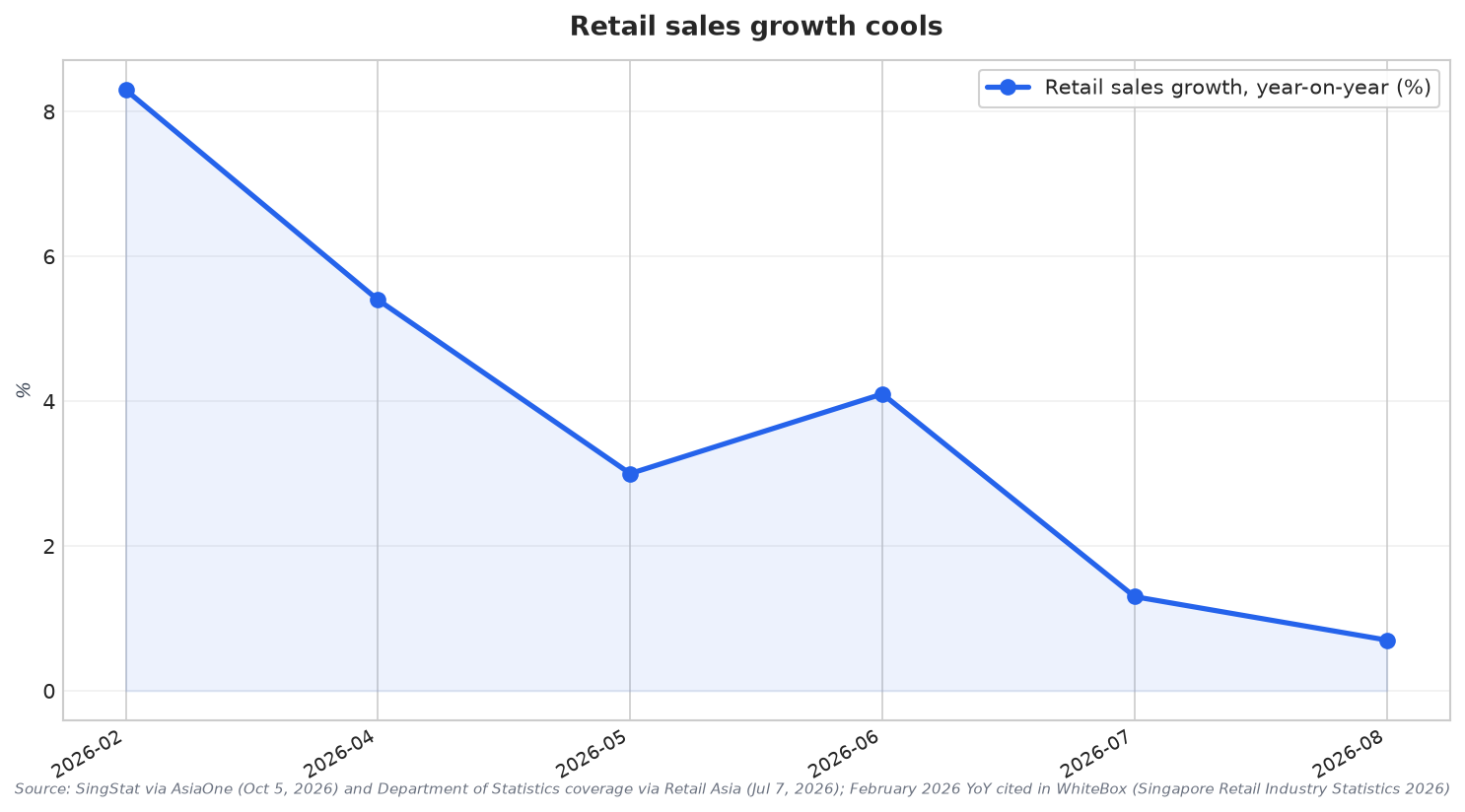
Singapore’s retail sales story in 2026 is one of deceleration, not collapse. After stronger year-on-year prints earlier in the cycle, the latest updates show momentum fading. Retail sales rose 8.3% year-on-year in February 2026 (SingStat), then slowed to 3% year-on-year in May 2026, easing from 5.4% in April (Department of Statistics, via Retail Asia). By August, growth cooled further to 0.7% year-on-year, which SingStat data described as the lowest since February, with total retail sales value at $4.5 billion. Month-on-month and seasonally adjusted retail sales also declined 1% in August, reversing a 0.6% rise in the prior month, reinforcing the sense that the slowdown is broadening beyond a single weak category.
Under the hood, the weakness is uneven across categories and that matters for interpreting the Singapore retail sales slowdown 2026 narrative. In August, eight of 14 tracked categories posted year-on-year growth, led by cosmetics, toiletries and medical goods (11.2%), computer and telecommunications equipment (10.7%), and recreation goods (4.3%). At the same time, several everyday and traffic-driving segments contracted: food and alcohol fell 1.1%, mini-marts and convenience stores slipped 0.6%, and watches and jewellery declined 2.7%. Motor vehicles, parts and accessories dropped 4.6%, the steepest decline among categories. Even where headline sales are still positive, these cross-currents show consumers shifting what they buy, not simply buying more across the board.
Online Mix Is Rising as Store Growth Cools
A rising online share is another key piece of why measured growth can look softer, especially for bricks-and-mortar-heavy segments. SingStat data cited by AsiaOne shows that 15.7% of total retail sales were transacted online in August, and excluding motor vehicles, parts and accessories the online proportion was 18.2%. Earlier in the year, online retail accounted for 15.1% of total sales in May, up from 14.7% in April (Retail Asia). Longer-term figures point the same way: online sales were estimated at 14.4% of total retail sales in January 2026 (SingStat, via WhiteBox). Put simply, more spending is flowing through digital checkouts, and the winners are often specific product lines rather than the broad middle of physical retail.
Sector structure and cost realities add more friction to growth. Mordor Intelligence estimates Singapore’s retail market at USD 50.38 billion in 2025 and USD 51.66 billion in 2026, with a projection to USD 58.56 billion by 2031 at a CAGR of 2.54% from 2026 to 2031. That is growth, but not the kind that guarantees strong year-on-year monthly retail sales readings. The same source highlights structural shifts toward omnichannel integration, plus wage inflation under the progressive wage model encouraging automation and self-service workflows. Real estate is another constraint: prime Orchard Road retail rents averaged about S$31.20 psf per month in Q1 2025 (Knight Frank, via WhiteBox), which can pressure retailers to rationalize footprints and focus on sales per square foot rather than chasing volume.
Finally, consumer spending appears increasingly selective, which can keep parts of the market buoyant even as the headline slows. Inside Retail Asia noted commentary that months of elevated prices at the pump and checkout have made people more careful with routine spending, while discretionary appetite can still hold up. That framing aligns with mixed August outcomes, where recreation goods grew but food and alcohol slipped, and with the observation that supermarkets, mini-marts and food and alcohol fell year-on-year in July coverage. Meanwhile, food and beverage services also softened: F&B services sales fell 1.6% year-on-year in August after a 1.9% decline in July, with total F&B sales around $1.7 billion and online transactions accounting for 20.6% of the total (SingStat, via AsiaOne). The result is a market where growth exists, but it is narrower, more channel-shifted, and harder to sustain month after month.
Why did Singapore’s retail sales growth hit a 14-month low in 2026?
Which retail categories grew fastest in August 2026?
How big is online retail’s share during the 2026 slowdown?
What does the data say about the Singapore retail sales slowdown in 2026 compared with earlier months?
Are food and beverage sales holding up alongside retail sales?