
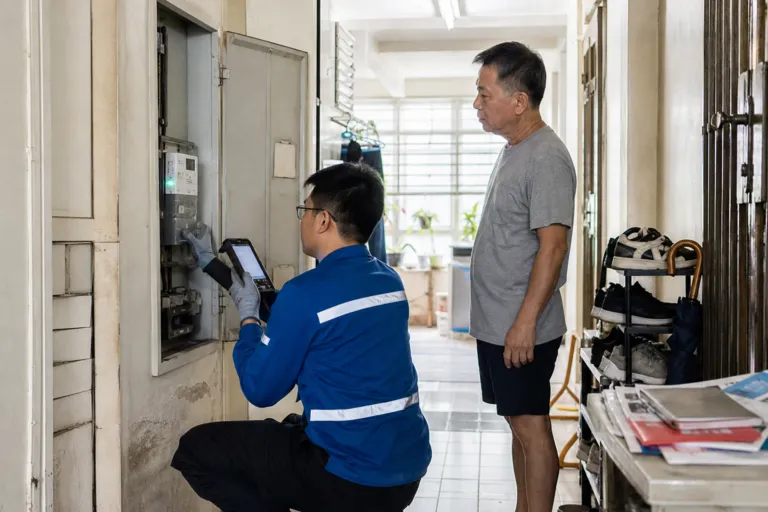
Dynamic electricity pricing works best when the grid can measure, communicate, and settle consumption data quickly and accurately. In Singapore, SP Group already plays a defined role in parts of the electricity bill that depend on reliable metering and data handling. SP Group states that network costs paid to SP Group recover the cost of transporting electricity through the power grid. It also states that the Market Support Services Fee paid to SP Group recovers the costs of billing and meter reading, data management, and retail market systems. This operational scope is part of why the conversation about smart meters and dynamic tariffs is not only about devices, but about the data backbone that supports tariff calculation and market processes.
Singapore’s electricity tariffs are reviewed regularly, and that review cadence matters for any move toward more responsive pricing. SP Group says it reviews electricity tariffs every quarter based on guidelines set by the Energy Market Authority (EMA). It also explains that the energy cost component of tariffs for each quarter is set using the average natural gas prices in the first two and a half months in the preceding quarter. That structure shows how pricing already responds to input costs on a fixed timetable. Smart metering strengthens the ability to reflect consumption patterns against those cost movements, because meter reading and data management are explicitly part of the Market Support Services Fee and retail market systems that SP Group maintains.
Why Smart Grid Capabilities Matter for Tariffs
Beyond billing, Singapore’s energy transition adds technical reasons for a smarter grid, which in turn supports more flexible tariff approaches. A Scientific Reports study on Singapore’s energy transition says that with strategic upgrades and smart grid technologies, Singapore’s grid can efficiently manage the variability and intermittency of renewable energy sources. The same study discusses integration of grid infrastructure with generated and imported renewables, highlighting solar photovoltaic and energy storage systems as part of the mix being examined. When variability becomes a core operational challenge, better measurement and control help the system plan and manage demand. Smart meters fit into that logic by turning household and business consumption into higher-quality operational information.
Climate pressures add urgency to grid modernization, and they also shape how policymakers and operators think about resilience and system planning. The Scientific Reports paper notes that Singapore experienced a temperature rise of 0.25 °C per decade from 1948 to 2015, and it points out that 2016 and 2019 were recorded as the hottest years. It also cites projections from a national climate change study, including sea level rise of 0.25 m to 1.15 m by 2100 and up to around 2 m by 2150, and a projected rainfall increase of about 6% to 92% in April and May by the end of the century. In this context, smarter grid operations and better data can support more adaptive pricing and demand-side behavior without claiming that any single meter automatically changes tariffs overnight.
It also helps to place Singapore’s direction within wider market momentum for grid digitalization, while keeping geography clear. A Statista overview describes smart grids as covering technologies such as Advanced Metering Infrastructure (AMI), network and distribution management, and electricity supply security. Separately, a smart meter market report cited by GlobeNewswire states that electric smart meters accounted for approximately 64.20% of revenues in 2025, and that Asia Pacific led smart metering in 2025 with around 30.90% of global revenue. The same source expects software to grow at a fastest CAGR of approximately 9.09% from 2026 to 2035, linked to demand for AI-based analytics, meter data management systems, demand response, and predictive grid monitoring software. For Singapore, these global signals reinforce why SP Group’s smart-meter and data systems, combined with EMA-guided tariff reviews, can be foundational for more dynamic tariff options over time.
How does SP Group’s role in metering connect to more dynamic tariffs in Singapore?
How often are Singapore electricity tariffs reviewed, and what sets the energy cost component?
What does research say about smart grid technologies in Singapore’s energy transition?
What climate signals in the sources help explain why grid modernization matters in Singapore?
What do global smart metering and software trends suggest for the SP Group smart meter dynamic tariff Singapore topic?