
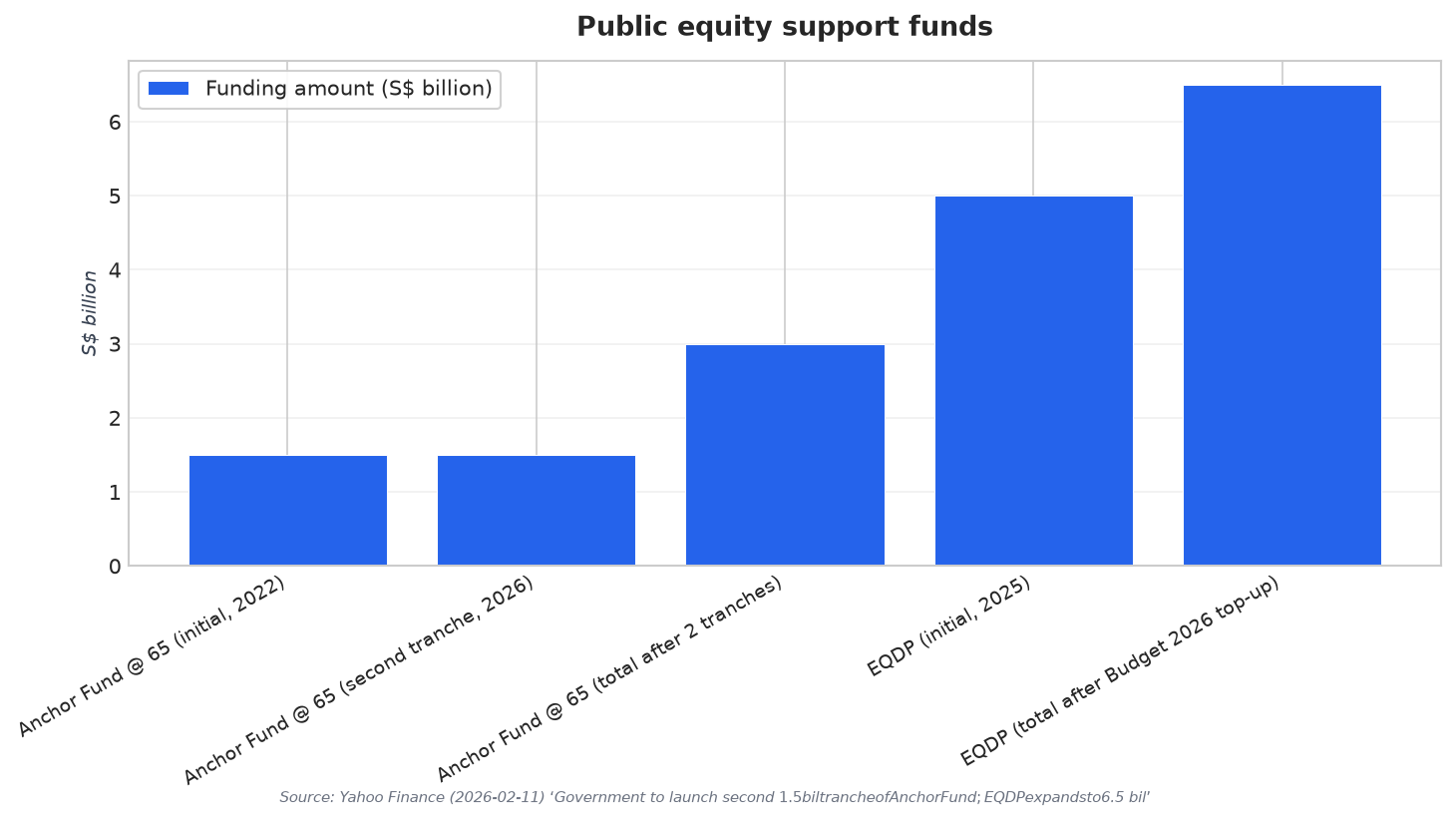
Singapore’s push to revive its public equities market is getting another major lever. In Budget 2026, Prime Minister Lawrence Wong announced a second S$1.5 billion tranche of the Anchor Fund, on top of the initial S$1.5 billion launched in 2022 under Anchor Fund @ 65. The second tranche brings the fund’s total to S$3 billion, and Wong said the new tranche, like the first, will be a co-investment between the government and Temasek. The fund is managed by 65 Equity Partners, a wholly owned subsidiary of Temasek, and it was set up to support and attract high-quality companies to list on the Singapore Exchange (SGX), including by investing before IPOs and anchoring public fundraising.
The policy intent is not to force IPOs, but to reduce the common friction points that make founders hesitate. Founders considering an SGX listing often worry about demand for shares, whether valuation will be attractive enough, and whether there will be sufficient liquidity after listing to sustain trading over the long term. Anchor Fund @ 65 positions itself as a partner that can invest pre-IPO, help companies prepare for listing, and then anchor the fundraising when they debut on SGX. In practice, the mandate referenced via EDBI’s factsheet includes supporting public fundraising through primary, secondary, or dual listings, while also providing pre-IPO financing to catalyse growth ahead of an eventual public listing.
What the Second Tranche Signals for SGX Liquidity and Deal Confidence
The second tranche lands alongside a broader capital-markets package meant to improve liquidity and participation. Wong also announced a S$1.5 billion top-up to the Equity Market Development Programme (EQDP), lifting the total thus far to S$6.5 billion. MAS has disbursed S$3.95 billion to nine asset managers so far, with the remaining S$1.05 billion to be distributed later in the year, and MAS is expected to announce a third tranche of managers sometime in 2026. SGX Group’s head of equities, Ng Yao Loong, said the moves reflect strong demand and growing confidence, with impact coming not just from the “quantum of capital” but also from disciplined deployment through active managers and efforts to strengthen liquidity, deepen research coverage, and widen investor participation.
There are also early proof points that the Anchor Fund can support real outcomes, especially for firms that might otherwise stay offshore. AvePoint, a Nasdaq-listed data management and governance tool provider, launched a dual listing on SGX in September 2025 after receiving an Anchor Fund investment in September 2023. Separately, Singapore recorded 16 listings on SGX in 2025, starting with local software-as-a-service provider Info-Tech’s debut in July. Taken together, the second tranche of the Anchor Fund and the expanded EQDP are being framed as a way to reinforce a pipeline of high-quality companies—both locally grown enterprises and promising firms from abroad—so they choose to build, grow, and anchor themselves in Singapore.
Still, the strategy has trade-offs that the market will watch closely. One risk highlighted in policy commentary is structural dependency: even if public funding injections rejuvenate activity, they may fail to trigger a self-sustaining cycle. That context matters because, while the fiscal commitment of over S$10 billion thus far is described as significant, it is also framed as less than 1 per cent of the SGX’s S$1.1 trillion total market capitalisation. For companies and investors evaluating the Singapore SGX Anchor Fund S$1.5 billion Temasek listings agenda, the real test will be whether capital, research coverage, and investor participation combine into lasting liquidity—so SGX becomes a more natural first-choice venue for IPO-ready firms and dual listings.
What is the second S$1.5 billion Anchor Fund tranche, and who is involved?
How large is Anchor Fund @ 65 after the second tranche?
How does the Anchor Fund support SGX listings in practice?
What is the EQDP, and what numbers have been announced for it?
What is one example of a Temasek-linked Anchor Fund outcome for SGX listings?