
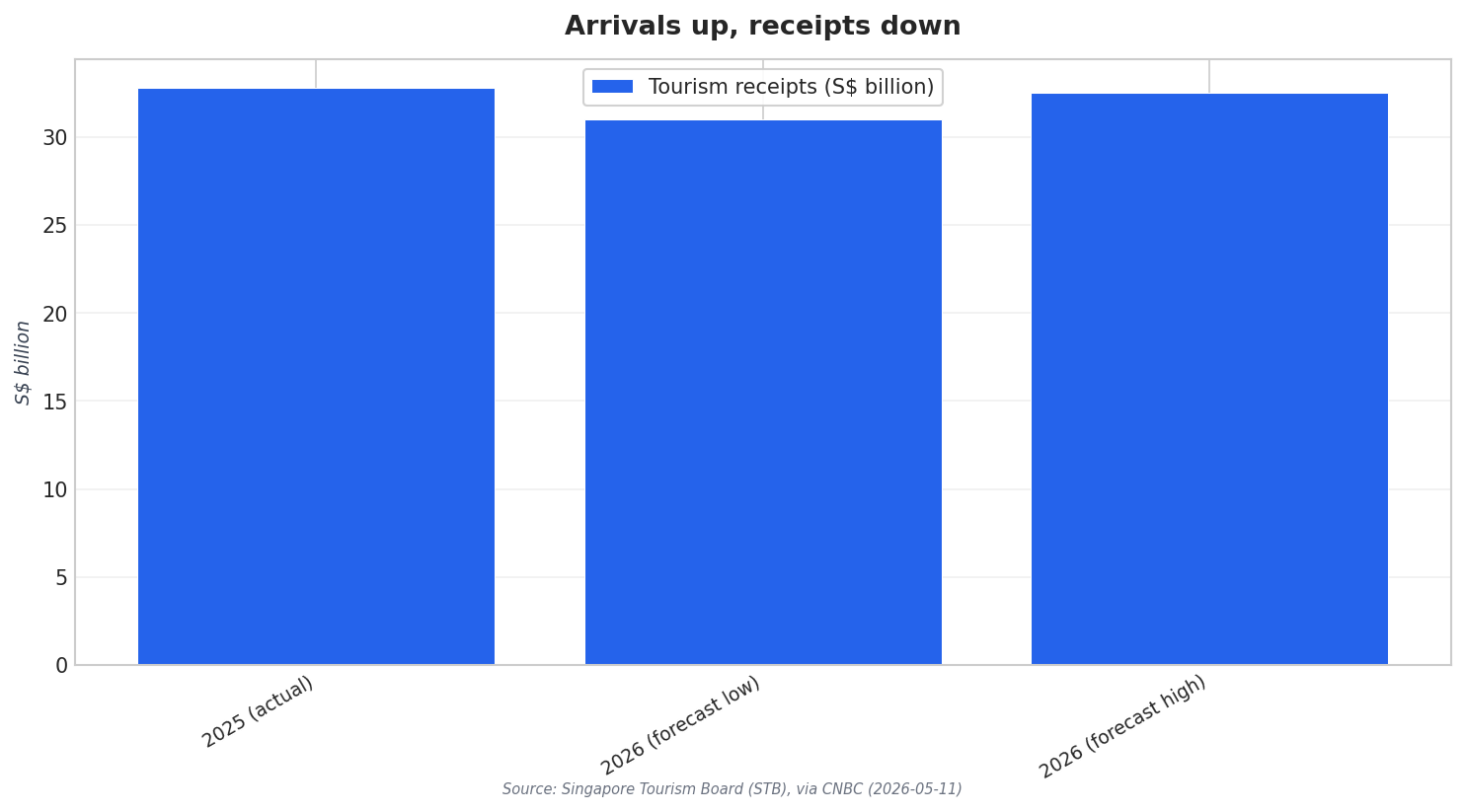
Singapore is heading into a rare tourism mismatch: arrivals are projected to rise, but total visitor spending is expected to soften. In 2025, the country recorded 16.9 million international visitor arrivals and S$32.8 billion in tourism receipts, which the Singapore Tourism Board (STB) described as a record. For 2026, STB is projecting arrivals of between 17 million and 18 million, yet it has guided receipts to a lower S$31 billion to S$32.5 billion range. That set-up is the core of the Singapore tourism receipts decline 2026 story: more footfall, but less money captured overall.
STB leaders have been direct about what is changing inside the headline totals. In March 2026, STB Chief Executive Keith Tan said “average spend per visitor is likely to moderate,” linking that shift to price-sensitive travellers choosing shorter stays and cheaper experiences. At Singapore’s annual industry conference, STB Chief Executive Melissa Ow also warned of “muted demands in the months ahead,” even though visitor arrivals were up 3% in the first quarter compared with a year earlier. Across the industry narrative, the issue is not whether people come, but whether they spend as much once they do.
Why More Arrivals Can Still Mean Lower Receipts
The sources point to a tourism economy that is splitting into high-yield and mass-market lanes. High-end assets and events are described as strong, including Marina Bay Sands operating at capacity and a corporate-events calendar that in 2026 included the first AAAI artificial intelligence conference ever held outside the United States. But below that tier, mid-market pressure is visible in business closures and vacancies. Singapore Department of Statistics data released in early 2026 showed retail and food-and-beverage business cessations rose 29% year-on-year in Q1 2026, with the sharpest concentration in central shopping districts. Orchard Road’s retail vacancy rate reached 7.1% in Q1, up from 6.6% three months earlier, while the downtown core posted vacancies of 6.3%.
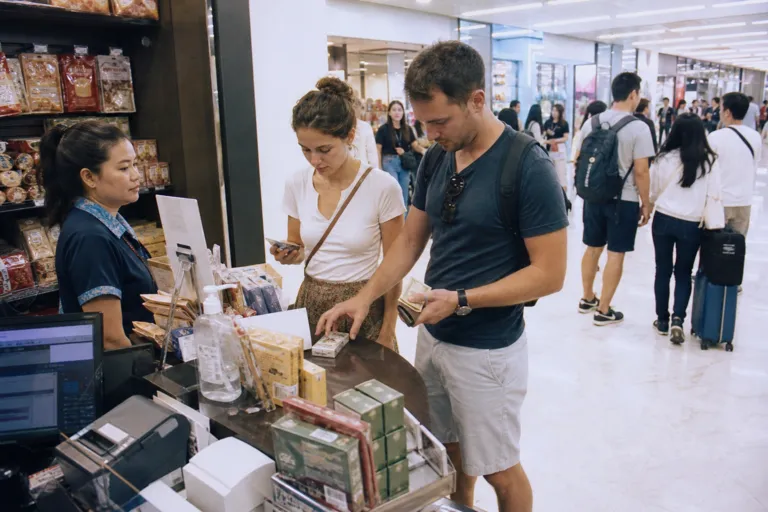
Cooling demand from price-sensitive regional markets is another drag on receipts growth, even if total arrivals remain resilient. Early 2026 data cited in reporting shows Indonesian tourist arrivals dropped 13.3% and Malaysian arrivals fell 14.7%, both important source markets for Singapore. Separate coverage also notes that visitors from key Asian markets, including China, Indonesia, Malaysia, India, Australia and South Korea, have been pulling back on discretionary spending. One sign of shifting behavior is that shopping has shrunk to less than one-fifth of the average visitor’s budget, limiting the upside that Singapore previously captured through retail and impulse purchases.
External conditions are also shaping how much visitors and companies are willing to spend. STB-linked reporting highlights geopolitical tensions in the Middle East and associated higher fuel prices as factors that can influence travel patterns and discretionary spending. In this environment, meetings and conferences are described as among the more resilient travel segments, but even business travel faces caution, with commentary that corporate travel globally has yet to fully recover to pre-pandemic levels while travel costs remain elevated. The stakes are meaningful for the broader economy: official records cited by STB show tourism accounted for about 6% of Singapore’s services exports in 2024, so any receipts slowdown can ripple beyond hotels and attractions.
Why are Singapore’s tourism receipts forecast to fall in 2026 even with more visitors?
What were Singapore’s visitor arrivals and tourism receipts in 2025?
What 2026 ranges has STB provided for arrivals and receipts?
What signs show the mid-market is under pressure in early 2026?
How important is tourism to Singapore’s wider economy?