
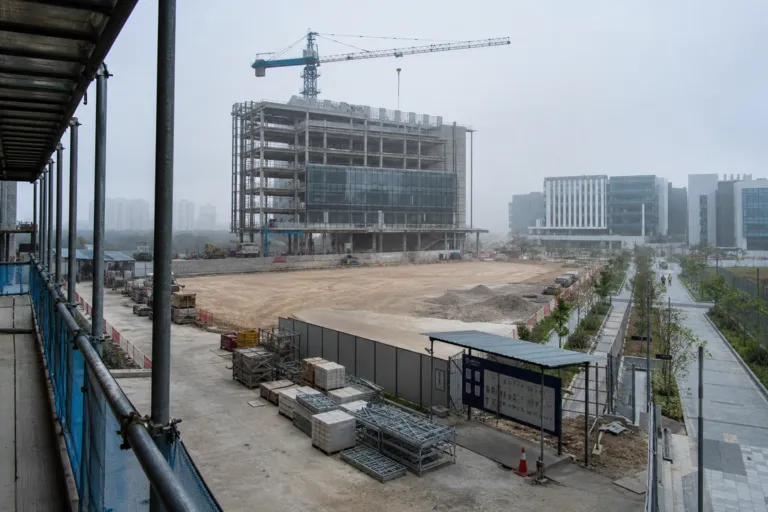
Singapore’s push to accelerate artificial intelligence is set to have real estate implications, especially in one-north and surrounding business park corridors. In Budget 2026, Prime Minister and Finance Minister Lawrence Wong described AI as a strategic lever and said the Government intends to establish a larger AI park at one-north, built by JTC. In his Budget speech on Feb 12, Wong mentioned “AI” 56 times, underlining how central the theme is to policy. Market watchers have linked this to stronger interest in high-tech industrial space, where purpose-built business parks can support the needs of AI firms, founders, researchers, and investors.
The planned park is being positioned as a focal point that brings communities together and helps translate AI initiatives into practical solutions for businesses and public services. In parallel commentary on property impact, analysts have pointed to a “flight-to-quality” effect in business parks, where AI-driven occupier demand is expected to favour high-spec assets over older buildings in one-north and the Science Park area. The Business Times also reported that the AI push could stimulate asset enhancement initiatives at older business parks, a pipeline signal that may show up as more refurbishment activity and competitive repositioning rather than pure new-build supply.
What Kampong AI Adds to the One-North Space Story
The larger one-north AI park is being delivered as “Kampong AI, Singapore’s Hub and Home for AI.” According to the Singapore Economic Development Board, Kampong AI will be the first startup community in Singapore with work and living spaces under one roof, and it is expected to be ready by 2028. SpaceCycle.sg reports the development will provide 14,500 sqm of event and business park space for up to 70 AI companies, with a pilot phase launched in March 2026 using existing workspaces at LaunchPad @ One-North. This is why the Singapore one-north AI park expansion 2026 matters for the pipeline: it points to staged absorption, from pilot space into more dedicated premises as firms scale.
Demand signals are also being framed around the broader ecosystem that one-north already hosts, including Biopolis, Fusionopolis, and Mediapolis, which gives occupiers proximity to research institutions and engineering networks. SpaceCycle.sg notes a pattern where AI scale-ups combine a CBD registered address with operational space in a one-north business park, and links occupier growth to the idea that firms are graduating from coworking into dedicated offices. The EDB also highlighted the wider startup and capital base in Singapore, noting the country is home to more than 4,500 tech startups and over 500 global venture capital firms and angel investors, a backdrop that can support sustained leasing momentum if space matches technical needs.
Beyond offices and business parks, the AI push is being connected to adjacent digital infrastructure needs. The Business Times reported that faster AI adoption could drive incremental demand for data centre capacity, while a separate analysis on industrial property described data centres as supply-constrained and highlighted how tenants value high-tech industrial units with strong power supply, robust floor loading, and proximity to established tech clusters such as one-north. For commercial property planning, that reinforces a selective pipeline thesis: buildings and sites that can be upgraded for higher specifications, or that sit within established clusters, may capture more of the next wave of occupier demand tied to AI, even as the market becomes more fundamentals-driven.
What is driving interest in one-north’s commercial space pipeline in 2026?
What is Kampong AI, and when is it expected to be ready?
How much space and capacity is planned for Kampong AI?
How could the one-north AI park expansion in 2026 affect older business parks?
Why is AI policy being linked to data-centre-adjacent industrial demand?