
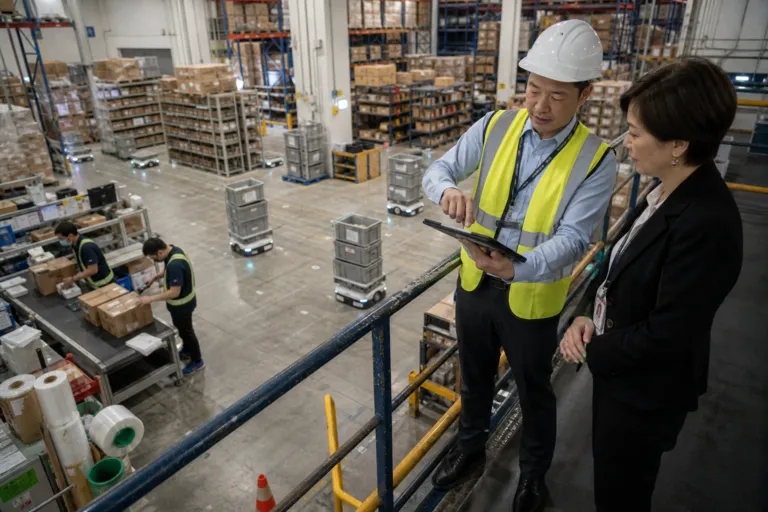
Distribution centres are being redesigned around automation-first workflows. Globally, warehouse robotics is projected to grow from USD 1.8 billion in 2025 to USD 6.6 billion by 2035, at a CAGR of 13.8%, as operators respond to rapid supply chain digitalization, rising labor costs, and the pressure for high-speed fulfillment. The shift is not just about speed. Sources also link robotic systems to fewer manual errors and more scalable operations. These dynamics set the backdrop for Singapore warehouse automation logistics, where robotics is increasingly treated as core infrastructure rather than a niche upgrade.
Singapore’s broader automation ecosystem is also expanding in ways that support robotics-led distribution. A market report values the Singapore automation and robotics manufacturing market at USD 87.6 million in 2024, with an approximated CAGR of 6% from 2024 to 2030. The same source frames demand around solutions that raise operational efficiency and reduce costs across sectors including logistics. Government programmes are part of the enabling conditions. The report cites “Industry Transformation Maps” encouraging technology adoption, plus SGD 1.6 billion allocated to enhance productivity and technology. It also notes that in 2022, total investment in R&D reached approximately SGD 12.5 billion, a 15% increase from 2021.
Why Funding and Payback Timelines Are Pulling Automation Forward
Financing structures and payback expectations can decide whether a distribution centre automates now or later. A Southeast Asia industrial and service robot market report states that governments are compressing payback periods by funding up to 70% of qualified automation outlays, reducing the capital needed for a six-axis unit from USD 50,000–70,000 to as low as USD 15,000–25,000. In the same report, upgrade grants covering up to 50% of retrofit bills in Singapore and Thailand are said to shorten ROI to below two years, helping SMEs move up the automation maturity ladder. The implication for robotic distribution centres is clear: retrofits can be staged, while new builds can be designed as automation-first from day one.
Operational capability is advancing alongside financing. In Asia-Pacific, market analysis highlights technological progress in AI, machine learning, and sensors as drivers of more capable robotic systems. It also points to collaborative robots, or cobots, designed to work safely alongside human operators. That same analysis projects a market growth rate of around 12% over the next few years, and separately cites estimates suggesting AI-driven robotics could increase by over 15% annually in the coming years. Quality and compliance pressures add another layer. The analysis anticipates robotics focused on safety and quality control expanding at approximately 9% annually, supported by advanced sensors and imaging for inspections and quality checks.
Singapore’s logistics ecosystem is also attracting targeted industry support. Stratview Research notes that in December 2022, OMRON launched an automation center in Singapore for logistics to support adoption of the Robotics Middleware Framework in the sector. Regional context shows both momentum and constraints. The Southeast Asia report says more than 3,000 new robot cells in 2025 were backed by programmes including Singapore’s Productivity Solutions Grant, alongside initiatives in Malaysia and Thailand. But it also warns that a shortage of advanced robotics talent outside Singapore can slow commissioning and service, citing that Thailand, Malaysia, and Vietnam together graduated fewer than 4,000 certified robot technicians in 2024 versus demand for almost 10,000 by 2027, with foreign engineer day-rates at USD 1,500–2,500 and startup windows extended by up to three months.
What is driving robotic distribution centres to become the default model?
How do grants and incentives affect automation decisions for warehouses?
What figures describe Singapore’s automation and robotics manufacturing market?
How fast is warehouse robotics growing globally?
What does Singapore warehouse automation logistics need to scale safely?