
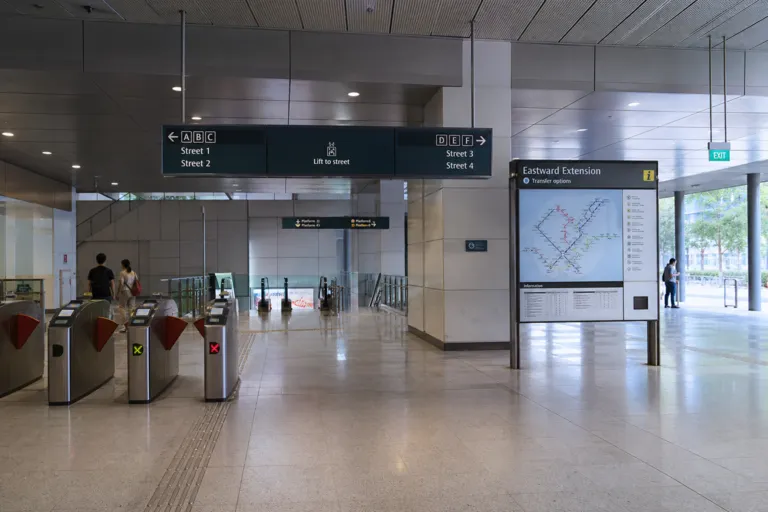
The Downtown Line (DTL) already runs from Bukit Panjang in the north-west toward Expo in the east and loops around the city centre. According to Wikipedia, the DTL is operated by SBS Transit and is Singapore’s longest automated MRT line at 41.9 kilometres, serving 35 underground stations. The next change is in the east. The Land Transport Authority (LTA) describes a two-station Downtown Line 3 Extension (DTL3e) that adds Xilin and Sungei Bedok. For commuters watching the Singapore Downtown Line 3 extension 2026 timeline, the key promise is simpler connections, not just another pair of stops.
LTA states that, in 2026, a 2.2km future extension of DTL3 from Expo station will join the East-West Line (EWL) and the future Thomson-East Coast Line (TEL) to help commuters transfer more easily between the DTL and TEL. LTA also highlights who benefits most directly: residents in the Marine Parade area can look forward to more travel options and easier transfers to the EWL and the future TEL with the addition of Xilin and Sungei Bedok. TheSmartLocal echoes that DTL3e comprises these two stations and points to easier access to Changi Business Park and Expo, while also framing the change as quicker trips to town for “Easties.”
What the Two New Stations Add to Everyday Transfers
The biggest commuter-facing impact is network choice. LTA notes that DTLe, together with TEL and EWL, will offer alternative routes for commuters in the region, which also means “more space on the train” as passengers spread across options. Wikipedia adds an operational timing detail, describing the two-station extension to Sungei Bedok as under construction and scheduled to begin operations from the second half of 2026. Put together, the value is not only a new endpoint beyond Expo, but a more seamless way to combine lines when heading toward town, or when switching across the east-side corridors served by the EWL and the future TEL.
Building these two extra stops is not described as straightforward. LTA explains that the new extension sits near water bodies such as the Sungei Bedok river mouth and several canals, and that tunnelling must be done amid a “dense maze of underground pipes.” It also cites thick marine clay and sand near the river mouth, requiring special construction methods to maintain tunnel structural integrity. LTA further notes that tunnel configuration is complex because multiple tunnel cells are needed for both the DTL and TEL main line and reception tracks. For commuters, this context matters because it frames why the project is carefully staged and why the goal is safe, disruption-free construction while still delivering new transfer options.
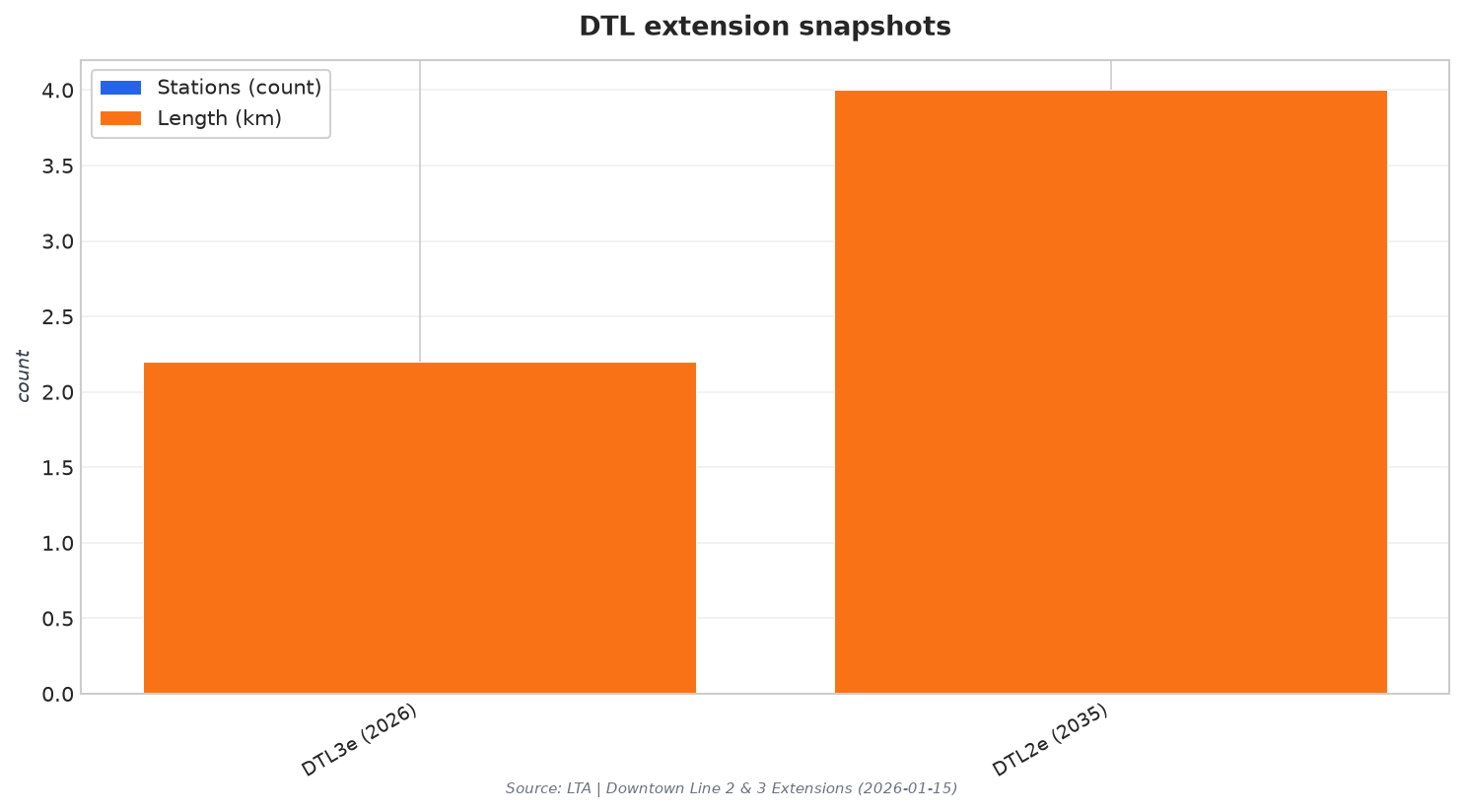
It also helps to see DTL3e within the broader set of DTL extensions. LTA sets DTL3e at 2 stations and 2.2km with expected completion in 2026, and separately describes the Downtown Line 2 Extension (DTL2e) in the west as 3 stations over 4km with expected completion in 2035, including an interchange (DE2) connected to a new aboveground station (NS6) on the North-South Line between Yew Tee and Kranji. LTA also states that, once DTL2e is completed, travelling from Yew Tee to Chinatown allows for 20 minutes of travel time savings. While that specific time saving is tied to the west extension, it signals the wider intent: use targeted links to improve transfers and reshape end-to-end journeys across the network.
What stations are included in the Downtown Line 3 Extension?
When is the Downtown Line 3 Extension expected to be completed and opened?
How does the Singapore Downtown Line 3 extension 2026 help commuters transfer between lines?
How long is the Downtown Line 3 Extension and how many stations does it add?
Why is construction of the DTL3e described as challenging?