
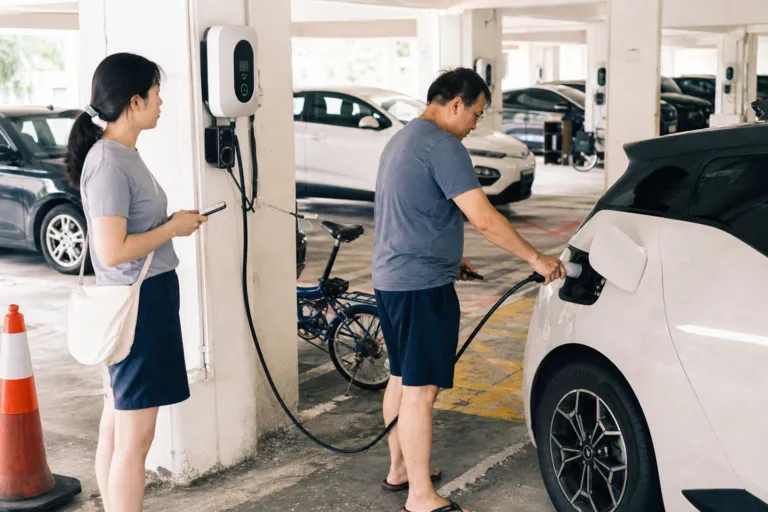
Singapore’s EV story is moving from “early adoption” to everyday reality, and charging standards are now part of what shapes consumer confidence. According to LTA statistics reported by CNA, EVs made up 57.6 per cent of new car registrations in the first quarter of 2026, up from 45 per cent recorded in the whole of 2025. At the same time, the government’s charging rollout is scaling, with 30,500 charging points deployed as of March toward a 2030 target of 60,000. In this context, a clearer national charging rulebook matters because it helps align quality, safety, and operations across an expanding island-wide network.
That rulebook is SS 722, which takes effect from 1 April 2026. LTA and Enterprise Singapore stated that the national EV charging standard, Technical Reference 25 (TR25:2022), will be elevated to a Singapore Standard and expanded with updated specifications and guidelines for the design, installation, maintenance, and operation of EV charging systems. The intent is practical: enhance safety and reliability, while supporting continued expansion through standardised technical practices that drive consistent quality across charging stations. The upgrade follows a public-private Working Group review overseen by Enterprise Singapore and supported by LTA, reflecting how policy and industry are converging on common technical expectations.
What SS 722 Adds: Wireless, Cybersecurity, DC Updates, and Battery Swaps
SS 722 is structured to cover emerging charging solutions, not just conventional plug-in setups. LTA’s factsheet highlights Part 1 on electrical safety and general requirements, updated to cater for new types of systems such as wireless charging stations, mobile charging systems, and battery charge and swap stations for four-wheeled vehicles. Part 2 addresses low-powered charging and wireless power transfer (WPT), including safety requirements so wireless charging stations “operate safely and do not pose any safety hazards,” and it also introduces cybersecurity requirements for Charging Station Management Systems and charging equipment communications. Part 2 also provides guidance on smart grid integration and supports smart charging capabilities for more efficient energy management.
For drivers who rely on fast public charging, SS 722 also tightens expectations for direct current (DC) stations. LTA said Part 3 has been updated to align with the latest International Electrotechnical Commission (IEC) standard and calls for stricter temperature controls, enhanced integrity checks on cable insulation, and more precise power output. Separately, SS 722 expands into battery swapping and mobile charging in a new Part 4. CnEVPost reported that this section establishes technical specifications for battery swap and mobile charging for passenger vehicles and heavy-duty trucks for the first time, signaling a broader view of how charging access might work. CnEVPost also noted Nio as a key contributor to the standard, and described the company’s wider standardisation track record and battery swap activity in China as context.
Standards do not replace infrastructure, but they can make rollouts easier to scale without sacrificing safety. Singapore’s 2030 target is 60,000 charging points, comprising 40,000 in public car parks and 20,000 in private premises, and CNA reported the deployment had reached 30,500 as of March. Meanwhile, NextMSC valued Singapore’s EV charging market at USD 63.03 million in 2022 and predicted it could reach USD 650.92 million by 2030, with a CAGR of 34.4 per cent from 2023 to 2030. With adoption rising and investment growing, SS 722’s focus on consistent technical practices, plus clearer guidance for wireless, mobile charging, and battery swap systems, can help remove uncertainty for developers, operators, and drivers as the network densifies.
When does SS 722 take effect in Singapore?
What does the Singapore EV charging standard SS 722 cover beyond traditional plug-in charging?
How does SS 722 address safety and reliability for DC fast charging?
How many EV charging points has Singapore deployed, and what is the 2030 target?
What do recent registration figures suggest about EV adoption in Singapore?