
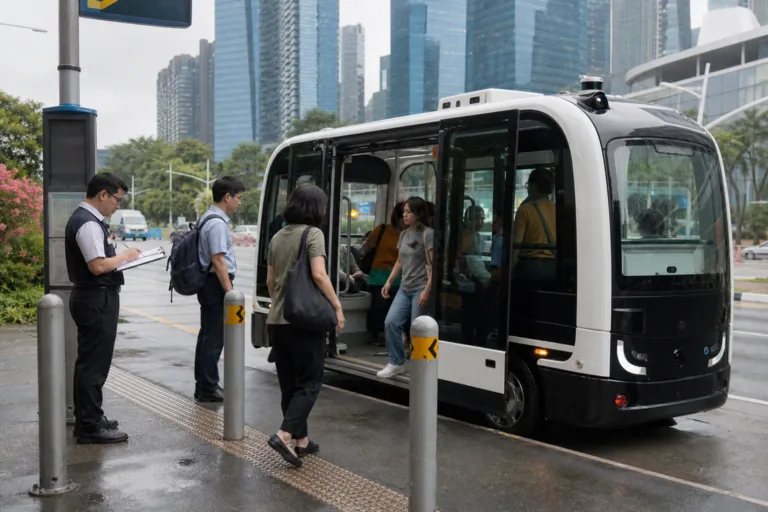
Singapore’s next step in autonomous mobility is moving from controlled trials toward real public routes. In January 2025, the government launched a tender for smaller autonomous public buses, with operations scheduled to start in mid-2026. The contract is valued at $6.2 million (S$8.1 million) and covers six 16-seater electric buses, plus AV software, hardware, and related systems. This push sits within a wider national effort: since 2015, Singapore has facilitated on-road AV trials at controlled sites, spanning use cases such as campus bus services, transport for airport workers, logistic vehicles, and more.
Reporting in March 2026 noted that the first of six autonomous public buses had already arrived in Singapore and was undergoing safety checks. The vehicles are part of a collaboration involving BYD, Zhidao Network Technology, and MKX Technologies. The buses are designed as 16-seaters and include cameras and sensors positioned at the front, rear, and roof to support a 360-degree view for operators. Before carrying passengers on open roads, the buses are expected to start in a closed-circuit setting to run drills such as turning and safely letting passengers on and off at the correct stops, then graduate to real streets alongside conventional buses.
Where the 2026 Trials Will Run and How the Pilot Is Structured
The planned public-route trials focus on two distinct areas and services. In the second half of 2026, self-driving buses will be trialled on two public bus routes in Marina Bay and one-north: services 400 and 191. Service 400 loops past Marina Bay landmarks and key stops, while Service 191 serves the one-north district and connects commuters to Buona Vista Bus Terminal and nearby MRT stations, including one-north and Buona Vista. The Land Transport Authority (LTA) will start by purchasing six autonomous buses, and they will operate alongside existing buses for an initial period of three years.
This Singapore autonomous bus pilot 2026 is also framed as a platform for scaling if the results are strong. If the trial proves successful, LTA has the option to procure 14 more driverless buses and expand the programme to additional routes across Singapore. Separately, the Trade.gov market note says the government aims to have 100-150 self-driving vehicles by 2026, and it outlines ambitions to expand deployment island-wide over the next five years to strengthen last-mile connectivity, reduce commute times, address manpower constraints linked to a bus-driver shortage, and enhance the public transport network.
Public acceptance and day-to-day reliability remain central to whether autonomous buses become routine. CNA reported that passenger trials began in Punggol earlier in 2026, with Grab and ComfortDelGro deploying autonomous shuttles. Grab said its autonomous shuttles, developed by WeRide, have provided more than 3,800 passenger rides, while ComfortDelGro said 700 passengers have experienced by-invite rides on its AVs, developed by Pony.ai. CNA also highlighted open questions raised by experts, including whether AVs can reliably mimic human decisions on the road and unresolved legal questions over liability in an accident involving an AV, with the Ministry of Transport seeking industry and public feedback on the legal framework.
When will Singapore’s self-driving public bus trials start on real routes?
Which bus services are included in the 2026 autonomous bus pilot?
How many buses are in the initial Singapore autonomous bus pilot for 2026, and what size are they?
What funding and contract scope has been stated for Singapore’s autonomous public bus procurement?
What could happen if the three-year pilot is successful?