
Singapore’s Electronic Road Pricing system is being overhauled into ERP 2.0, and the practical impact on motorists is simple: a new on-board unit must be in the vehicle. The system is shifting from physical gantries to satellite-based positioning using Global Navigation Satellite System (GNSS) technology, which the Land Transport Authority (LTA) says will remove the need for physical gantries once the installation exercise is completed. For drivers, this is not just a tech refresh. It is a deadline-driven hardware change that affects how road pricing charges are recorded and paid, and it changes what you see (and do not see) when you enter ERP charging locations.
The compliance line is fixed. From 1 January 2027, every Singapore-registered vehicle on a public road must have an OBU installed. Installation began in November 2023, and by 31 January 2026 about 930,000 OBUs had been installed, which is stated as more than 93% of Singapore-registered vehicles. LTA started issuing final reminders on 15 February 2026 to vehicle owners who still had not installed. Those reminders matter because they also define the tail end of the free installation period: each final reminder gives three more months of free installation from when it is received.
Costs, Components, and the Real Deadline Pressure on Drivers
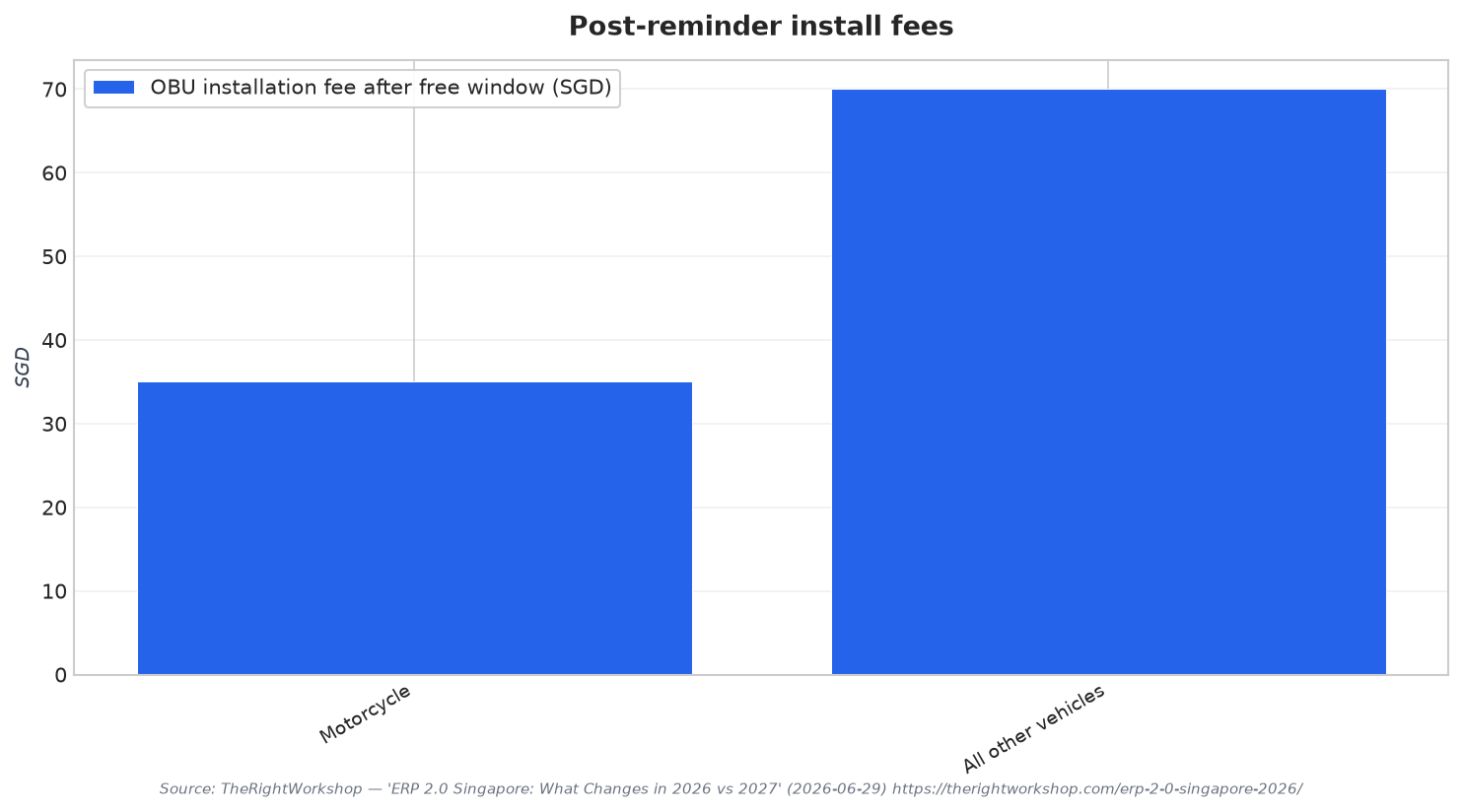
For drivers who miss the free window, the costs in the sources are explicit. After the three months from a final reminder, LTA charges $35 for a motorcycle and $70 for every other vehicle (excluding GST, as stated in one source). New cars registered from 1 May 2024 already come with an OBU, and one source lists the unit price as $158.70 with GST. Hardware also varies by vehicle type. A car OBU is described as a three-part setup: a processing unit, an antenna, and a touchscreen display, with the touchscreen optional if the driver prefers to use an app. Motorcycles get a single-piece unit, and the touchscreen is optional via app use rather than a separate bike display.
Drivers also face a transition in how charging feels on the road. Singapore has 95 ERP gantries island-wide today, and non-operational gantries are being removed progressively through 2026. However, charging is described as still happening at existing ERP points rather than by distance travelled, even as the physical gantries come down. Multiple sources note that ERP 2.0 is running but not charging by distance, and in March 2026 the Ministry of Transport said it does not intend to implement distance-based charging in the immediate term and would give adequate notice if that changed. Practically, the “beep” moment becomes less visible, but charges can be checked in the OneMotoring app.
Not every vehicle is treated the same, and drivers should confirm whether they fall into an exception category. One source states that about 5% of vehicles are exempted, including certain types used for construction purposes such as tractors, and some types used at airports and ports. For everyone else, payment behavior changes too. A source notes that the old chip-based CashCard no longer works, and payment happens via the OBU using a CEPAS card in the unit (examples given include EZ-Link Motoring, NETS FlashPay, or NETS Motoring) or via a backend motoring payment account. The biggest driver takeaway for the Singapore ERP 2.0 on-board unit mandate 2027 is that the deadline is firm, and waiting past the reminder window can turn a free swap into a fee-based appointment.
When does the ERP 2.0 OBU become compulsory for Singapore-registered vehicles?
How many vehicles had installed the new OBU by 31 January 2026?
What does it cost if I miss the free installation window after LTA’s final reminder?
Are ERP gantries still used under ERP 2.0?
What should drivers know about the Singapore ERP 2.0 on-board unit mandate 2027 deadline?