
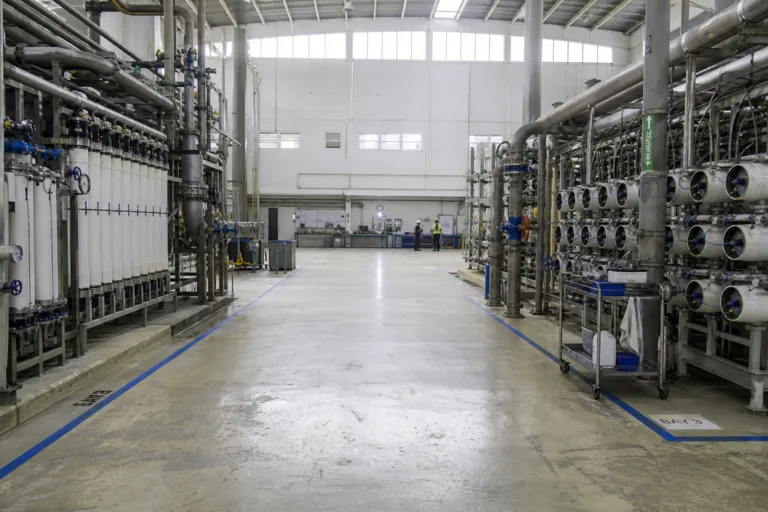
Singapore’s NEWater brand name is used for highly treated reclaimed wastewater produced by the Public Utilities Board (PUB). It is made by further purifying conventionally treated wastewater through microfiltration, reverse osmosis, and ultraviolet radiation. The result is potable-quality water, and it can be added to drinking water supply reservoirs, where it is later treated again at conventional water treatment plants before distribution. Even so, most NEWater is currently used for non-drinking purposes, mostly by industries that need high-purity water. That split matters when people discuss a “nation’s biggest water-recycling plant” because NEWater is designed to serve both high-grade industrial demand and broader supply resilience.
The interest in a Singapore fifth NEWater plant 2026 also sits in a longer planning arc. Singapore considered water recycling to augment its limited fresh water supply starting in the 1970s. A Master Plan drafted in 1972 identified water reclamation and desalination as alternatives to reduce dependence on imported water from Malaysia. An experimental water reclamation treatment plant was built in 1974, but it was terminated after only one year due to costs and reliability issues. In 1998, PUB and the Ministry of the Environment and Water Resources initiated the Singapore Water Reclamation Study to determine if NEWater was a viable source of raw water, alongside desalination as a path to reduce reliance on imported water.
How NEWater Won Public Trust and Scaled to National Supply
NEWater was launched to the public in 2003 with the opening of the first two NEWater plants, Bedok and Kranji, and the NEWater Visitor Centre. The rollout was careful in how it talked about recycling, avoiding terms such as “wastewater” or “sewage,” and renaming sewage treatment plants to “water reclamation plants.” It also relied on exhibitions, advertisements, and the Visitor Centre to explain how NEWater is produced. Today, multiple sources describe NEWater as one of Singapore’s “four national taps,” with drinking water supported by local catchments, imported water, NEWater, and desalination. That messaging foundation helps frame why a fifth facility can be positioned as a major, mainstream addition rather than a niche project.
Scale is not abstract in Singapore’s case. PUB states that NEWater factories have a supply capacity of 760,000 m3/day, described as almost 40% of national water demand. Another source similarly states that Singapore’s NEWater initiative met 40% of the nation’s total water demand in 2023. This is also presented as proof of centralized reuse at commercial scale, not only a pilot concept. In a broader Asia-Pacific context, one market report says the region leads global water reuse with a 38.2% revenue share valued at about $5.4 billion in 2025, and it explicitly includes Singapore among countries implementing large-scale reclamation infrastructure.
The wider market backdrop reinforces why major utilities keep investing in advanced treatment trains. One global report sizes the water recycle and reuse market at USD 38.6 billion in 2024 and forecasts USD 89.4 billion by 2034, with a CAGR of 8.8%. Another report projects the global water reuse market to grow from $14.2 billion in 2025 to $34.8 billion by 2034, a CAGR of 11.3% for 2026–2034. Those reports also highlight the same families of technologies used in NEWater—membrane filtration, reverse osmosis, and disinfection—showing how Singapore’s approach fits a broader trend. For readers tracking Singapore’s fifth and largest NEWater facility planned for 2026, the most important takeaway is continuity: proven processes, public acceptance practices, and a national role already measured in both capacity and demand share.
What is NEWater, and who produces it in Singapore?
How is NEWater treated before it is used?
How much water can Singapore’s NEWater factories supply today?
How much of Singapore’s water demand did NEWater meet in 2023?
What should I know about Singapore’s fifth NEWater plant planned for 2026?