
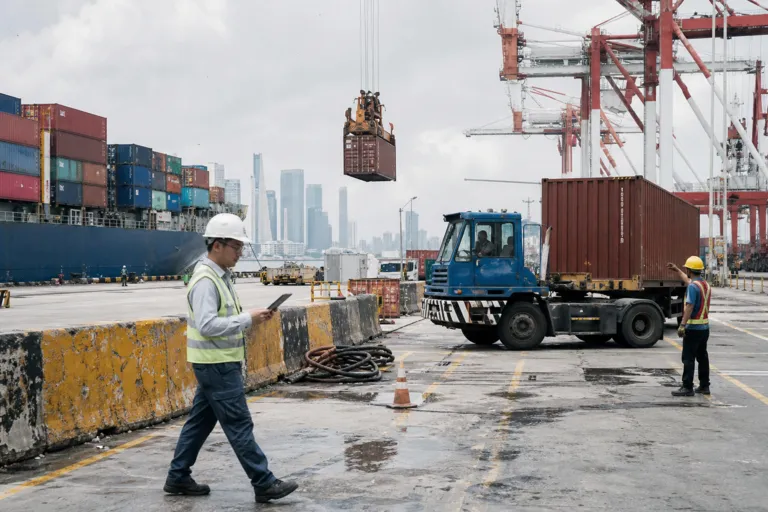
Singapore’s recent performance has become a real-world stress test for supply chains. Container throughput hit a record 41.12 million TEU in 2024, and the Maritime and Port Authority of Singapore (MPA) reported a new record of 44.66 million TEU in 2025. MPA also stated the 2025 total was an 8.6% increase from 2024, alongside a record 3.22 billion gross tonnage (GT) of vessel arrivals, up 3.5% year-on-year. Taken together, the figures show how a major hub can keep cargo moving while shippers and carriers adapt routes and schedules under pressure.
Those record volumes matter because Singapore is not just a destination port. In the Singapore maritime market analysis cited by Mordor Intelligence, about 85% of 2024 throughput was transshipment cargo. Verified Market Research also frames Singapore’s throughput as being approximately 85% to 90% transshipment, linking growth to rising trade volumes and hub-and-spoke transfers between mainline routes and regional networks. That mix is a key signal for global trade resilience: when disruptions happen, cargo can be re-routed, re-connected, and re-timed through nodes built for vessel-to-vessel transfer and dense service connectivity.
What the Records Reveal About Resilience Under Disruption
The record-setting years arrived amid operational volatility. Mordor Intelligence notes Red Sea diversions added up to two weeks on Asia-Europe schedules and pushed 90% of sailings off timetable, increasing spillover and yard-density pressure at legacy terminals. At the same time, the market context includes EU Emissions Trading System (EU-ETS) surcharges compressing liner margins, which adds cost and planning complexity for operators. Singapore’s response has leaned on tools and coordination, including predictive-analytics berth allocation via digitalPORT@SG, and readiness measures to keep vessel traffic and cargo handoffs predictable even when upstream schedules are not.
Resilience is also being built through capacity and systems planning, not just day-to-day operations. Mordor Intelligence estimates the Maritime Sector in Singapore market size at USD 15.41 billion in 2026, up from USD 14.78 billion in 2025, with projections reaching USD 18.97 billion by 2031 at a 4.25% CAGR over 2026-2031. The same analysis points to accelerated automation at Tuas Port and highlights a Tuas Port target of 65 million TEU annual capacity by the 2040s. For the keyword topic of Singapore port container throughput record 2026, the message is that recent records are being reinforced by longer-term scaling and automation plans.
Energy and digital standards are part of that resilience story because they affect port attractiveness and service continuity. MPA reported marine fuel sales of 56.77 million tonnes in 2025, surpassing 54.92 million tonnes in 2024. MPA also reported alternative marine fuels rising to 1.95 million tonnes in 2025 from 1.35 million tonnes in 2024. Alongside volumes, MPA stated that Singapore established two new Green and Digital Shipping Corridors with India and the Republic of Korea in 2025, and elevated the corridor with China to the national level, bringing the total to nine, with 2026 projects planned around common emissions-reporting protocols, enhanced digital exchanges, and fuel trials.
What record container throughput did Singapore report in 2025?
How does transshipment shape what these volumes mean for global trade resilience?
What disruptions were linked to schedule delays around Singapore’s hub role?
What does the Singapore port container throughput record 2026 topic point to beyond the headline TEU numbers?
Which fuel-related records did MPA report for Singapore in 2025?