
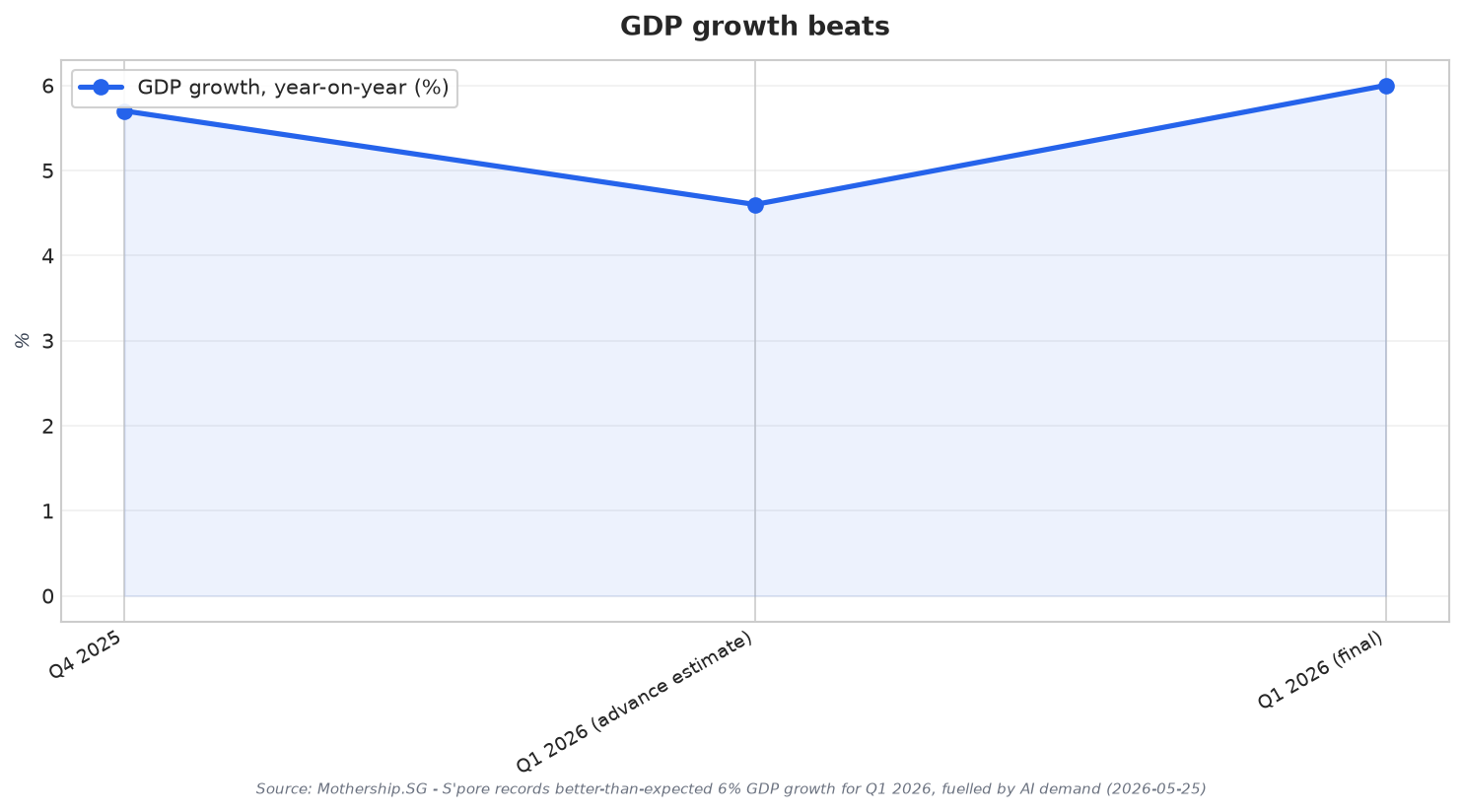
Singapore delivered a surprise start to 2026. The Ministry of Trade and Industry (MTI) reported that GDP rose 6.0% year-on-year in Q1 2026. That result was stronger than MTI’s advance estimate of 4.6%, and it also exceeded the 5.7% year-on-year growth recorded in Q4 2025. On a quarter-on-quarter seasonally adjusted basis, the economy expanded 1.0% in Q1 2026, easing from 1.3% in Q4 2025. The common thread in official commentary and media coverage was that AI-linked demand, rather than broad-based consumption, did much of the heavy lifting.
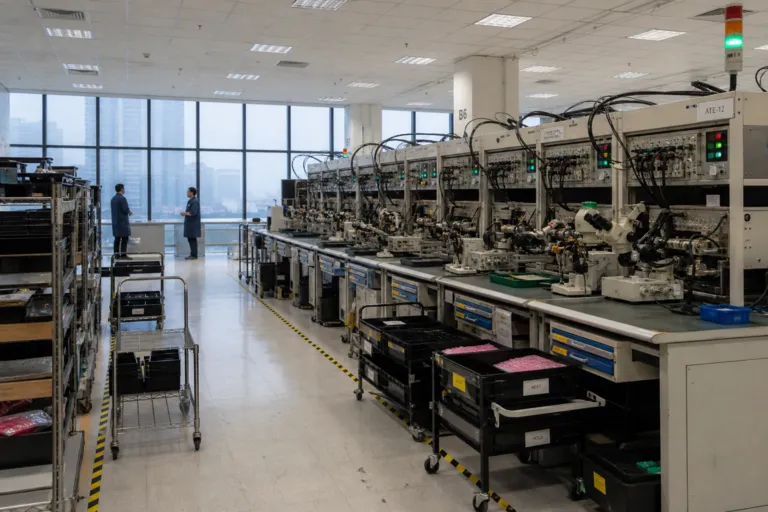
The driver was described as “robust AI-related demand” feeding directly into both manufacturing and trade. MTI highlighted growth in the machinery, equipment & supplies segment of the wholesale trade sector, alongside the electronics and precision engineering clusters within manufacturing. As a major electronics hub, Singapore also recorded higher production of memory chips and server components tied to data centers powering AI tools. In external trade, official statistics cited exports rising 9.6% in Q1 versus a year earlier, with the electronics sector named as the key contributor. In separate reporting, electronics exports were described as soaring 57.8%, reinforcing the picture of an AI hardware upcycle pushing activity across multiple parts of the economy.
Why the AI Export Engine Didn’t Fully Clear the Clouds
Even with the headline beat, policymakers did not declare victory. MTI kept its full-year 2026 GDP growth forecast unchanged at 2% to 4%, despite the Q1 outperformance. The reason was risk, not a lack of demand. MTI warned that tensions and conflict involving the U.S., Israel, and Iran could disrupt shipping through the Strait of Hormuz, contributing to a spike in crude oil and derivative product prices. Shortages and higher input costs were linked to contraction in related segments of wholesale trade and manufacturing. MTI also noted that sectors directly dependent on natural gas, crude oil, and derivatives had weakened, with oil refineries and petrochemical crackers reducing run rates and trading volumes in fuels and chemicals falling.
Trade policy uncertainty added another layer. MTI flagged the possibility of U.S. “reciprocal” tariffs returning in the second half of 2026, even after a temporary constraint from a Supreme Court ruling, as the U.S. President was expected to use other tools to pursue similar tariff outcomes. Against that backdrop, the AI story remained central to Singapore’s near-term growth narrative. MTI said AI-related demand had stayed strong and should support regional growth through the year, with sustained global AI-related capital spending. Expectations also remained that demand for AI-related semiconductors, including networking and memory chips from the data-center end market, would stay robust for the rest of 2026.
For readers tracking Singapore GDP growth 2026 AI demand, the Q1 pattern matters because it shows how AI-led electronics activity can spill over into other sectors. MTI explicitly linked the electronics cluster’s strength to positive spillover effects for the machinery, equipment & supplies segment of wholesale trade. It also expected steady growth in information & communications, supported by continued enterprise demand for AI-enabled and other digital solutions. In short, the quarter’s 6.0% year-on-year outcome was not just one sector “getting lucky.” It reflected connected supply chains, from manufacturing output to exports, with AI hardware and related business spending sitting at the center of the better-than-expected result.
What was Singapore’s GDP growth in Q1 2026, and did it beat estimates?
Which sectors benefited most from AI-related demand in Singapore?
How did exports perform in Q1 2026, and what drove them?
Why did MTI keep its 2026 full-year GDP forecast unchanged despite strong Q1 growth?
What does the Singapore GDP growth 2026 AI demand theme suggest for the rest of 2026?