
Singapore has set aside S$37 billion for its Research, Innovation and Enterprise (RIE) 2030 plan over the next five years, starting from April 2026. National Research Foundation (NRF) leaders said the investment is approximately 1 per cent of GDP, a level Singapore has maintained in prior RIE plans. The new plan represents a 32 per cent increase from RIE2025’s S$28 billion. As a framing of Singapore RIE2030 research funding of S$37 billion, officials described the emphasis as outcomes that strengthen the economy, improve effectiveness and build competitiveness, while also addressing strategic national priorities.
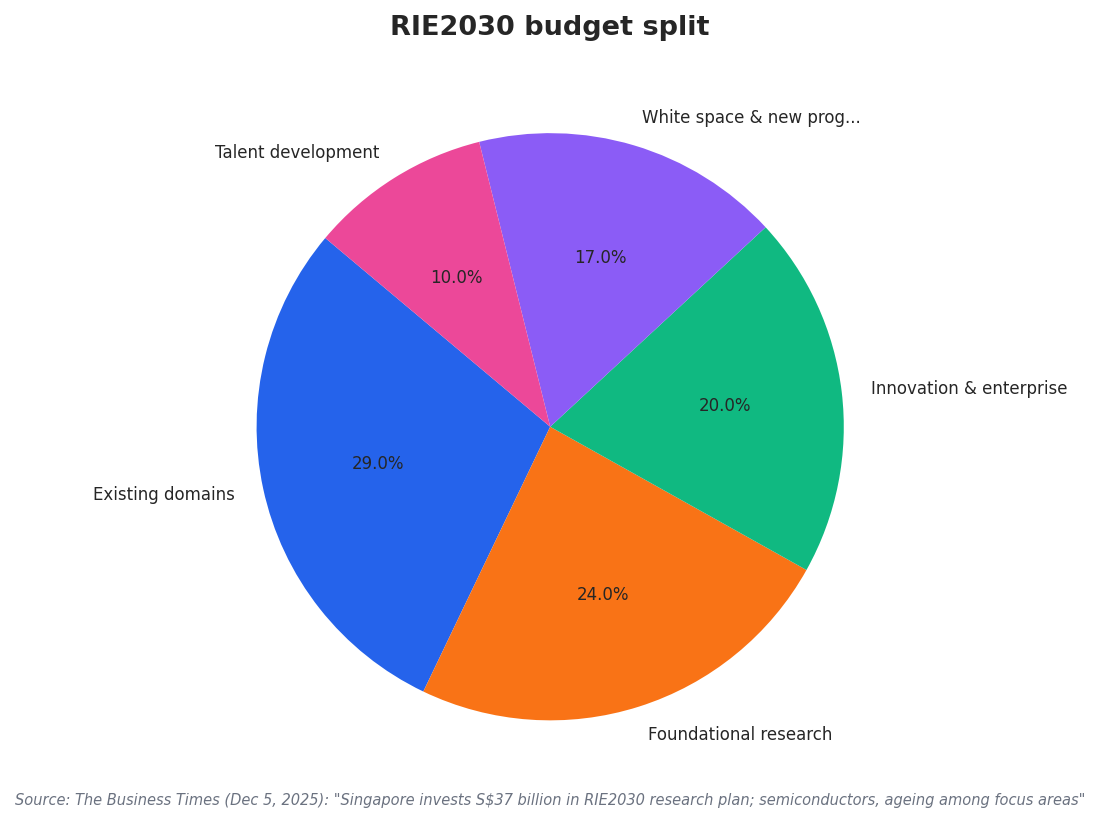
RIE2030’s budget is split across several components, and the plan makes the allocations explicit. Some S$10.8 billion, or 29 per cent of the overall RIE2030 budget, is set for four existing domains: manufacturing, trade and connectivity; human health and potential; urban solutions and sustainability; and smart nation and digital economy. Beyond the domains, the budget includes foundational research (24 per cent), innovation and enterprise (20 per cent), “white space” such as physical infrastructure and new programmes (17 per cent), and talent development (10 per cent). Compared with RIE2025, the plan also changes execution: each domain will now oversee its own innovation and enterprise efforts, enabling more end-to-end, sector-specific strategies.
Grand Challenges, Flagships, and Why Translation Is Central
Within the S$37 billion plan, 8 per cent, or S$3 billion, will go to new high-level programmes described as “Flagships” and “Grand Challenges”. These are designed as large national programmes with a strong mission focus. Senior Minister Lee Hsien Loong said each national programme will build a coordinated portfolio of research projects focused on one important sector or area, aiming to create more value and impact. The first announced areas include the semiconductor industry and longevity research, with one more flagship and one more grand challenge yet to be announced. The plan also explicitly aims to complement these programmes with support for early-stage research translation and enterprise innovation activities across fields and sectors.
Collaboration and industry alignment also sit at the centre of RIE2030’s approach. NRF chairman Heng Swee Keat said Singapore’s investment is a small fraction of what the whole world invests, making it critical to collaborate strategically with strong institutions and industry partners in Singapore and abroad. The plan includes a new Singapore-Horizon Europe Complementary Fund to support Singapore-based researchers participating in Horizon Europe projects that have received grants in priority areas for Singapore, and NRF will set up national contact points to help local researchers participate in Horizon Europe grant calls. On the industry side, Professor Tan Chorh Chuan said multinational corporations involved in partnerships under the manufacturing, trade and connectivity domain have not scaled back despite trade tensions, and there is growing interest in Singapore’s R&D.
RIE2030 also makes talent a visible line item, both through a stated 10 per cent budget share for talent development and through specific examples. The Straits Times reported that S$3.5 billion will go towards supporting talent development, including an NRF postdoctoral award that provides a S$250,000 research grant and up to four years of salary support. The plan is also framed against signs of venture and startup momentum: Senior Minister Lee said deep-tech startups in Singapore have attracted S$1 billion or more in venture capital funding annually over the past five years. Taken together, the plan’s funding scale, its domain governance changes, and its mission-led programmes define how Singapore is positioning research to feed both national priorities and economic value creation.
How much is Singapore investing under RIE2030, and over what period?
How does RIE2030 compare with RIE2025?
What share of the budget goes to the four main domains in RIE2030?
What are the RIE Flagships and Grand Challenges funded under the plan?
What does the Singapore RIE2030 research funding plan of S$37 billion prioritise besides sector domains?