
Singapore has long relied on natural gas for electricity, with gas accounting for 96% of its power mix, according to Rystad Energy. That dependence shapes both price exposure and the pace of decarbonisation. A new strategy is emerging: build regional interconnections, primarily via subsea cables, to link national grids and enable cross-border electricity trade. Rystad argues this shift can help decouple domestic electricity prices from global gas market volatility while accelerating decarbonisation. The same analysis says that if all proposed interconnections to Singapore are realised, they could unlock up to 25 GW of renewable and energy storage projects worth more than $40 billion across the region, spanning hydropower, solar, and offshore wind.
The climate case is also framed in concrete terms. Rystad Energy estimates imports enabled by these projects could deliver emissions reductions of up to 13 million tonnes of CO₂e per year if all projects are realised. Ember similarly positions regional grids as central to Singapore’s energy future under the Singapore Green Plan 2030, noting an aim to boost solar capacity to 2 GW and build up to 4 GW of interconnections to import clean electricity from neighbours such as Indonesia, Viet Nam, and Cambodia. Ember also points to a longer-run trajectory: solar generation set to grow from less than 1 TWh in 2023 to 5.1 TWh in 2035, while renewable imports reach 26 TWh.
From Pilot Trade to Subsea Scale: What Changes Next
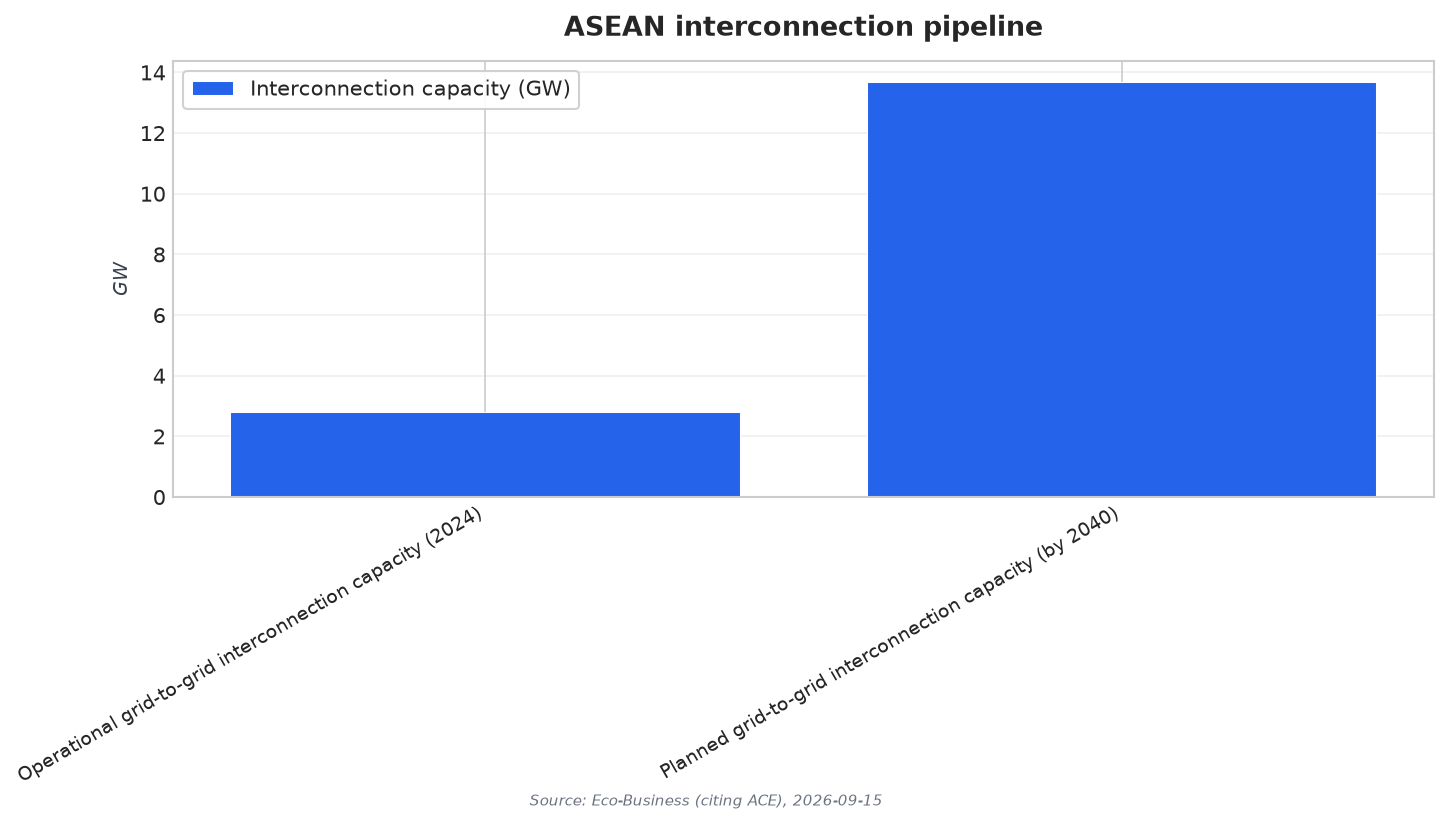
Progress is already visible at the ASEAN level, although the build-out remains early. Eco-Business, citing ACE, reports ASEAN had 2.8 GW of operational grid-to-grid interconnection capacity in 2024, with another 13.7 GW planned by 2040, and that six future submarine interconnections have been identified. The same report highlights the practical proof point: power can be traded commercially through several separately regulated markets, but scaling beyond that requires alignment. It also quantifies the financing gap: cross-border interconnectors alone will require about US$27 billion by 2040, while only about US$2 billion has been invested in Southeast Asian cross-border interconnectors over more than five decades, according to the IEA.
Subsea projects can reshape who participates in power trade, especially in archipelagic Southeast Asia. Reccessary argues that sustained political support is driving concrete progress and notes two breakthroughs in the last three years: a shift from purely bilateral electricity trading to a multilateral framework, and consistent momentum towards subsea power cable projects. It cites the Lao PDR-Thailand-Malaysia-Singapore Power Integration Project (LTMS-PIP) as the region’s first multilateral power project, commissioned in 2022. Reccessary adds that most proposed subsea projects use solar, wind, or hydropower, and points to industrial spillovers, such as Singapore’s collaboration with Indonesia involving not only solar energy exports but also solar PV manufacturing plants.
Yet the Singapore-centric grid vision is not just an infrastructure story. A 2026 Wiley letter describes Singapore’s regional interconnection as an inherently condensed network with low-voltage underground cables, and anticipates dramatic changes in grid characteristics. It flags that control, operation, and electricity trading with cross-border renewable energy (RES) power plants will become highly complicated and challenged, spanning stability analysis, operational security, risk-based dispatch, and market design. The paper also warns of emerging market risks, such as market power held by large generation companies, and highlights a need for strategic power bidding tools for importers. In this 2026 outlook for Singapore’s ASEAN Power Grid subsea interconnection agenda, the technology, the rules, and the market structure must evolve together.
How large is Singapore’s current dependence on natural gas for power?
What could proposed interconnections to Singapore unlock across the region?
What does ASEAN’s interconnection pipeline look like today?
How much investment is needed for cross-border interconnectors, and how much has been invested so far?
What is the key focus of the Singapore ASEAN Power Grid subsea interconnection 2026 discussion?