
Labour costs on site can move fast when wage floors and wage norms rise. Singapore’s Progressive Wage Credit Scheme (PWCS) was introduced in Budget 2022 to provide transitional wage support for employers to adjust to mandatory wage increases for lower-wage workers covered by the Progressive Wage Model and Local Qualifying Salary requirements, and to voluntarily raise wages of lower-wage workers. In Budget 2026, the Government said it has supported about S$3.6 billion of PWCS funding to over 110,000 employers for wage increases given between 2022 and 2024. The median monthly increase supported was about S$250, across more than 710,000 workers. For site operators, these figures show the scheme’s scale and why the extension matters for forward labour costing.
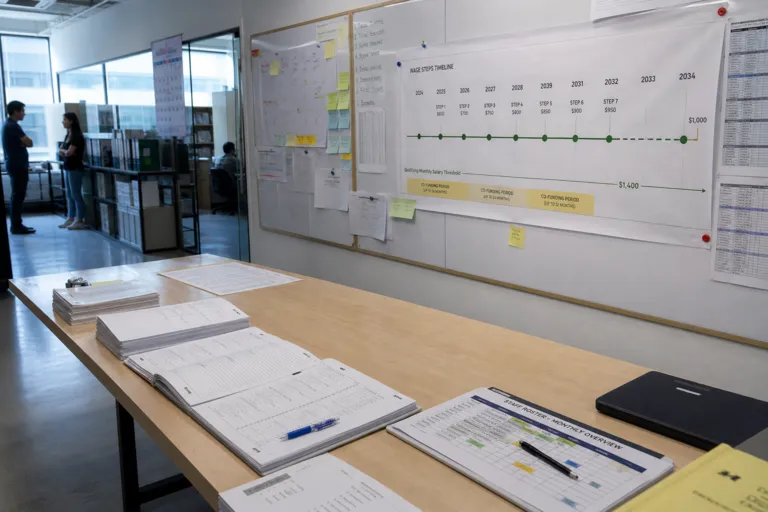
The main planning shift is the extension and the co-funding levels. PWCS will be extended to 2028, with co-funding support raised to 30% for 2026 (up from 20%), held at 30% in 2027, then set at 20% in 2028. For site-based workforces, this changes the net cost of wage moves and can influence whether you phase increases in one step or across years. The scheme co-funds wage increases of eligible resident employees from 2022 to 2028, and employers do not need to apply. IRAS states that employers can expect to receive the payout for the respective year by the first quarter of the following year, which affects cash flow planning even when the wage cost hits the payroll immediately.
What Changes in 2027-2028 Mean for On-Site Wage Budgets
From 2027, the minimum wage increase to qualify for PWCS support rises from S$100 to S$200 for qualifying years 2027 and 2028. This is a practical breakpoint for project teams building annual increments into site labour budgets. If your planned adjustments are smaller than S$200 on average gross monthly wage for eligible employees, they may not trigger co-funding in those years. PWCS design details also shape who counts. Support for wage increases up to a $3,000 gross monthly wage ceiling will run from 2022 to 2028, and employees’ average wage must be $4,000 or lower to be eligible for PWCS. From 2024 onwards, employees whose average monthly wage exceeds $4,000 post-wage increase will not be eligible.
Site employers should also account for the “two-year” nature of support. IRAS explains that eligible wage increases in each qualifying year will be co-funded for two years, as long as the increase is sustained (for example, a 2025 wage increase is supported in 2025 and also in 2026 if sustained). This can change the effective cost curve for multi-year projects. It also interacts with eligibility rules on payroll presence and CPF contributions. A firm automatically qualifies if it gives wage increases to resident employees who received CPF contributions from a single employer for at least three calendar months in the preceding year, and have been on the firm’s payroll for at least three calendar months in the qualifying year.
Finally, treat PWCS as part of a broader wage-cost environment. Budget 2026 also raised the Local Qualifying Salary from S$1,600 to S$1,800 in 2026 for full-time employees in firms that hire foreign workers, which can affect baseline site wage structures. Separately, commentary around the scheme emphasizes it is transitional. Manpower Minister Tan See Leng said PWCS is meant to be temporary to cushion near-term cost impact so it “remains a catalyst, not a substitute, for productivity improvement.” If you are aligning wage actions with the Singapore Progressive Wage Credit Scheme extension 2028, plan the qualifying increases deliberately, map who stays within the wage ceiling and eligibility cut-offs, and time cash flows around the first-quarter payout.
How does the Progressive Wage Credit Scheme extension to 2028 change labour cost planning on site?
What were the recent results of PWCS support in Singapore?
When should employers expect PWCS payouts after giving wage increases?
Which wages and employees are covered under PWCS design rules?